



Next-generation CDW recycling
Adjustable screen sizes, customisable magnetic separation stages, air classifiers: these technologies enable more than just the standard processing of mixed construction and demolition waste (CDW). Modern building materials recycling plants also excel in material-specific processing campaigns. For example, clean concrete rubble is produced as an aggregate for the concrete industry – and immediately afterwards, road rubble is processed for use as drainage material in landfill sites. Recycled aggregates, consisting mainly of materials such as concrete, asphalt, bricks, gravel, sand and natural stone, are recycled in accordance with the technically required mass proportions and, with a customised grading curve, are reused as secondary materials for applications such as base and subbase courses in construction.
The product journey
OVERVIEW OF TECHNICAL COMPONENTS
Pre-Screening and Post-Screening // Material classification
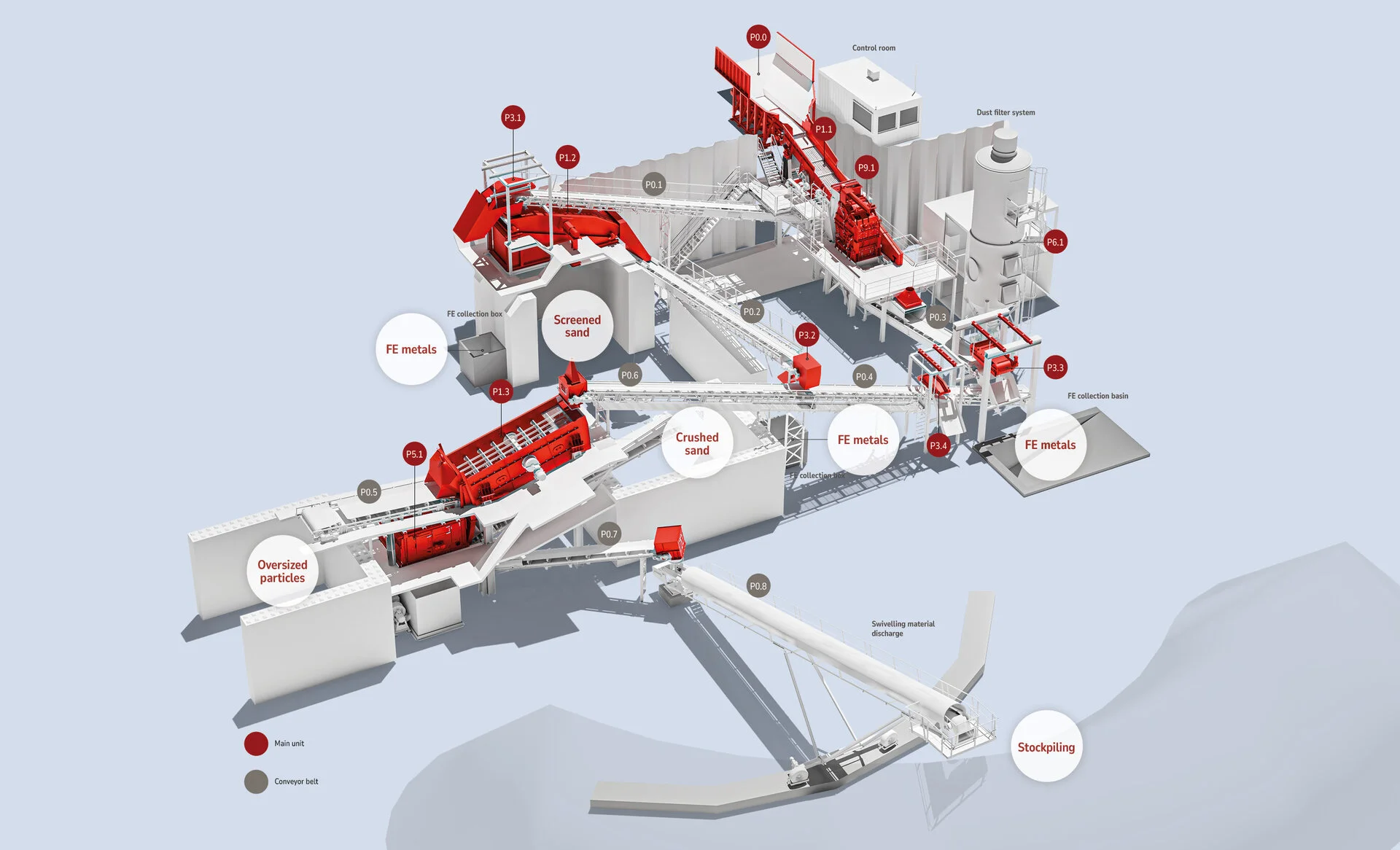
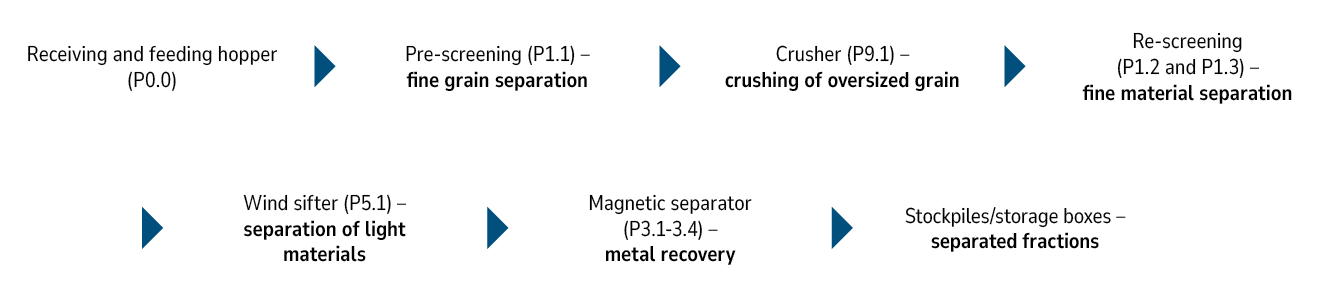
Material classification is the first stage in the plant’s process. During pre-screening, fine particles are separated from the oversize material, and only material larger than 45 mm is fed into the crushing process. Following crushing, a three-deck circular vibrating screen carries out further classification into defined particle size fractions.
Multiple screening stages ensure a continuous flow of material and create optimal conditions for the subsequent process steps.
Highlights
- 3-deck circular vibrating screens
- variable screen mesh inserts
- defined particle size fractions (0–5 / 5–20 / 20–45 / 45-x mm)
- optimised material flow
Impact crusher // Crushing
A key element of a modern plant is the replacement of a commonly used jaw crusher with a high-performance impact crusher.
The flexibly adjustable gap width allows the desired final particle size to be precisely tailored to different materials. The robust design enables highest throughput rates whilst ensuring ease of maintenance.
Highlights
- state-of-the-art impact crusher
- hydraulically adjustable gap width
- low-maintenance
Wind sifter // Material cleaning
A two-way windsifter combines an air stream with mechanical recirculation. A drum rotating in the opposite direction to the air flow prevents valuable mineral components from being carried away. This significantly improves the quality of the mineral fraction.
Highlights
- two-way windsifter
- efficient separation of light materials
- recirculation of heavy components
- improved mineral contentialik
Magnetic separator // Metal separation
Several magnetic separators are integrated along the material flow and ensure the continuous recovery of ferrous metals.
Through multiple separation stages, both coarse and fine ferrous particles are reliably recovered. At the same time, the magnets protect the downstream plant components from damage.
Highlights
- multiple magnetic stages (coarse to fine)
- continuous ferrous metal recovery
- protection of plant equipment
- optimised material flow
Staubfilteranlage // Emissionsschutz
A high-performance dust filtration system ensures that dust is extracted directly at the source.
The filtration system features automatic compressed-air cleaning and achieves a residual dust level that provides lasting improvements to plant operation, as well as to health and safety and environmental protection.
Highlights
- autoautomatic filter cleaning
- reduction in residual dust
- low-emission plant operation
Control room and plant automation // Digital process control
A central control room forms the digital heart of the plant. State-of-the-art visualisation software, camera systems and production data acquisition enable the monitoring and control of all process steps.
Automatic lubrication systems, belt weighers and standardised control software continuously provide operational data and support cost-effective and safe plant operation.
Highlights
- camera system
- production data acquisition
- belt weighers
- automatic lubrication systems
- standardised plant visualisation
To find out more about recycled aggregates made from construction and demolition waste, and their potential applications, please visit the REMEXIT website